
• Skip to primary navigation
  • Skip to main content
Jerusalem Intl Fellows

Jerusalem Intl Fellows

A Cultural Residency Program in East and West Jerusalem

  • About Us
    • What We Do
    • Who We Are
    • Past Fellows
    • Supporters
    • Selection Process
  • Host Organizations
  • Press
  • Blog
  • Donate
  • Translate
    • العربية

Blog

INTENSE

Elise Bernhardt · Apr 29, 2022 · Leave a Comment

Intense is the only word that (almost) adequately covers the weeks since I last posted.  Between the Fellows finalizing plans for their projects, bringing their teams together and jumping into the complex works they are each creating and the tensions going on with the collision of Ramadan, Passover and Easter, especially in the Old City it has been INTENSE.

I will share a bit about what each Fellow is working on below.  In terms of the current situation, I will say that thank god that everyone is safe.  There have been some scary moments. Two of our fellows were in Tel Aviv the day of the shooting.  They were close to where it took place, thankfully not at the time it did.  But we in Jerusalem were extremely frightened til we knew they were safe.

Last week, two of our fellows had received passes to Holy Fire from Vibha’s new Armenian friend (the one who introduced her to woodworkers in Bethelehem and the Armenian Father at the Church of the Nativity…)  Their friend could not get to the Old City because traffic was blocked but they contacted friends who were already there to welcome Vibha and Anna, who were SO excited to be able to experience this incredible event.  However, when they arrived at the entrance their passes were torn up by police who were extremely hostile to them and who ignored the pleadings of the Armenians who told the police that the women were their guests. (Read more about Holy Fire and these “security” occurrences, which happened to many others, here.)

Nonetheless, the work continues.

Anna’s salon engaged the public in her work on Synchronicity through weaving.  She and partner Gre created a complicated “machine” that takes the touch or the shuttle on the threads to make sounds created by a singer. Several weavers are connected, each with their own rhythm.  If it sounds hard to describe and difficult to understand, it is even harder to do!  We wil post videos soon – which will make it all clearer.  I can say that it is exceptionally beautiful and that Anna’s work with Neuroscientists as well as the Bloomfield Science Museum staff makes it a true weaving of science and art.

Claudia is working on two dance projects – one with Catamon Dance Group directly – a performance at the Brown Hotel which will take place on May 12.  Claudia has created a duet for two dancers on the bar.  It will be filmed so we who can’t attend will be able to see it.  Her other project is a dance video she is creating in collaboration with her partner Alex.  She has chosen two sites – the one outdoors was going to be at the beautiful nature preserve Ein Prat, but when permission was denied she found another site – and made friends with 2 Bedouins who now want to be part of her production team. The other location is a tiny room inside the Tower of David.  We will get to see some of the unedited videos at her final presentation. The finished video will be projected as part of Catamon’s festival this fall.

Claudia, who is a master collaborator, is structuring her upcoming salon all about collaboration in the dance world. 

Vibha’s project has gone through multiple iterations as she has figured out a way to represent her experience of Jerusalem in the context of Muslala’s upcoming rooftop festival.  And the limitations of time and budget.  She has created an extraordinary grid of the branches of the 3 Abrahamic religions in order to identify expert scholars and musicians (including the amazing Victoria Hannah)  from these different groups to talk about the relationship between humans and nature from the perspective of their texts.  With the help of local filmmaker Aaron Paz, she is documenting each of these experts and the final result – audio and video, will be viewed/heard as part of an installation made of stone that will be on Muslala’s rooftop.   And possibly in a larger scale version at the Tower of David.

Sofia created an extraordinary structure for her students at Ibdaa School of the Arts, using the creative devices she employs herself to help them develop their own work.  She was working 3 days a week (even during Ramadan!,) taking them to different museums and helping them develop ways of re-interpreting and layering images they have photographed on their cellphones.  She has also introduced them to a number of other local artists including Alon Kedem, laying the groundwork for other artists in Jerusalem to continue the work she is doing with them, to help them understand that making art is about self-expression and giving them tools to achieve that. I am looking forward to seeing the works in progress they share at their final presentation on May 6.

In addition to all this, here the Fellows are connecting with Jerusalemites in many other ways.  Vibha and Sofia will be presenting at the class of Sarah Benninga at Bezalel.  Vibha also presented one of her films and talked to students at Ibdaa followed by an Iftar meal organized by Ibdaa’s amazing Principal, Melhem Bader.  Claudia just taught a fantastic Master class at the Jerusalem Academy of Music and Dance.  And lots more connections continue to be made and expanded on.

It is strange how quickly the time has passed.  And yet it seems the Fellows have been here a very long time.  I am already missing them.
The Work Begins – April 6

Elise Bernhardt · Apr 26, 2022 · Leave a Comment

The Fellows started their journey here 4 weeks ago.  They know how to get around the Old City.  And the “New” one.  They have made friends, earned great admiration and are receiving invitations to numerous events and gatherings.  They know where the cool bars are and where to find great hummus.

They are all working intensively on their projects and designing their salons with their Host organization partners.  Tonight Vibha, in collaboration with the Jerusalem Food Rescuers, is presenting the most extraordinary evening: Who Owns The Water on Muslala’s beautiful rooftop.  The remarkable menu only conveys part of this brilliant and deeply thoughtful process with the extraordinary culinary creations creating the map of the Jordan River. I had such a great time working with Vibha as a volunteer in the Food Rescuer’s kitchen during the “cooking/testing/tasting” session, .

Next week Sofia will present her Salon at the Ibdaa School for the Arts in Sheik Jarrah.  She has been meeting with teachers and students there and has devised a brilliant program for the young people she will be working with (during Ramadan!)  In her salon, she will talk about bringing her artistic practice to Palestinian youth.  The gathering will start with a traditional Iftar meal (where an Ibdaa student will be playing music) followed by Sofia’s presentation and a discussion with a carefully “curated” group of educators, philosophers, artists, and curators.  

In spite of all reports, it is calm here in Jerusalem.  We visited Bethlehem last weekend, led on a fantastic tour by Palestinian curator, Aline Khoury.  We experienced the long drive around the city (which is actually very close to Jerusalem) required to get to the proper checkpoint.  Aline took us to the “Walled Off” Hotel (famous for Banksy’s work)  and a very sobering tour of the separation wall.  Then, because Ramadan started a day earlier than expected, Aline packed a lunch for us which we ate at the beautiful Al Jacir House where she helps run an artist residency program. After lunch we headed to the Church of the Nativity, with a wonderful excursion to Mike’s Ceramic Shop on the way.  Father Abdel, who Claudia had met during a previous visit to the city with an olive wood carver Vibha had met while visiting the Armenian church (this is the magic of our Fellows), took us around the Church and explained the different Christian faiths who inhabit the Church.

This Saturday – supposed to be a very hot day – we will visit Tel Aviv with a stop at Chiriya, aka Ariel Sharon Park, a garbage heap transformed into an incredible recycling center/park. The master plan included major participation by the artist Mierle Ukeles.  Who we will meet while we are here.

Disorientation Week, part 2

Elise Bernhardt · Mar 25, 2022 · Leave a Comment

After the whirlwind
Or
The dust is not really settled

Yesterday it snowed in Sfat. It poured in Jerusalem. It continues to be cold and windy and occasionally the brilliant desert sun pours through the clouds and everything glows in the incredible Light of Jerusalem (thank you Davidson Norris.) Someone said it is the coldest March in Jerusalem in 100 years!!! Sadly for our Fellows it has been too cold for them to enjoy their beautiful garden. Not that they’ve had much time.

I promised to try and capture the last few days of “disorientation” week. Which actually ran about 10 days when you include Purim plus an incredible tour of the Israel and Contemporary Galleries of the Israel Museum by their respective curators, Amitai Mendelson and Adina Kaiman. Each of them spoke SO eloquently about several extraordinary works of art, explaining the thinking behind the collections and the ways they are exhibited. I have a radical new understanding of Nimrod , the sculpture by Itzhak Danziger, which is the connector between the archaeological wing and the contemporary Israeli wing.

But I am ahead of myself.

We last left our heroines at Ruth Cummings’ beautiful Shabbat table (some for their first shabbat). The next day was intense. Artist and guide Raya Hallak took us to several important institutions in East Jerusalem, from the Ibdaa school, where the students spoke and performed and gave each of the Fellows beautiful bouquets (Photos on IG:), to the Palestinian Heritage Museum to the Duban Dance School in Beit Hanina. Their young director, Hana, talked about his struggles to build the company and school – based on the traditional Dabka but expanding to contemporary dance – without taking any funds from any government agency. And the difficulties of being “on the seam” – between East and West Jerusalem.

From there we went to the El Hakawati theater and then to a sumptuous lunch followed by a conversation with two Palestinian artists — filmmaker Juman Darghmeh and visual artist Benji Boyadgian (yes Armenian, lives in Bethlehem) at the Educational Bookshop. It was an exhausting day both physically and mentally but it wasn’t over. After a quick rest at home, we were off to meet Elias Khoury – an important Palestinian lawyer. Elias and his wife and daughter, Aline – an important curator of Palestinian art – welcomed us into their home in Shuafat. His address was not findable on WAZE or Google Maps – a phenomenon that apparently is not unusual in these parts of East Jerusalem – and thankfully a kind man in a nearby town led us to Elias’ house. After tea, we were treated to a lovely dinner at the Ambassador Hotel in East Jerusalem and regaled us with tales of lawsuits and challenges (won and lost) on behalf of Palestinian homeowners. Aline, a member of our Advisory Board, also talked with us about difficult situations her peers experience. A very sobering day.

The next day we had a tour of several art spaces in West Jerusalem led by Elad Schechter, Director of CATAMON dance group and host of choreographer Claudia Lavista. Many of these small organizations are housed in old buildings that are waiting for developers to overhaul them. Notable was the beautiful old Shaarei Tzedek Hospital which is home to, among others, the Jerusalem Biennial. We met with its founder and director, Rami Ozeri, and learned about the extraordinary growth of his unusual endeavor, which focuses on Jewishly influenced art from around the world.

A delicious vegetarian lunch was had in the beautiful cafe of Hamifal (the Factory.) This collective of artists transformed another fantastic old building. And there were artists making and selling fabulous Purim costumes. The Fellows went home to prepare for the Launch Event at Feel Beit.

The launch was a huge success. The house was full, including young people from the Ibdaa School, local artists, and many arts supporters. I was especially delighted to see documentary maker Toby Perl who I have known since the FJC days (she was a recipient of a film fund grant) and Andi Arnovitz, an amazing artist and long time friend of this program. The Fellows’ presentations were quite moving and everyone fell in love with them!

Not content to rest, on Monday, we were led on a wonderful tour of Hamirpeset – the rooftop space of Muslala – the organization hosting artist Vibha Galhotra – by their director, Matan Israeli. Matan explained the complicated history of Muslala’s work in Musrara (the “No Man’s Land” neighborhood where the Fellows are living.) And we discussed Muslala’s different models for creating communities around sustainability.

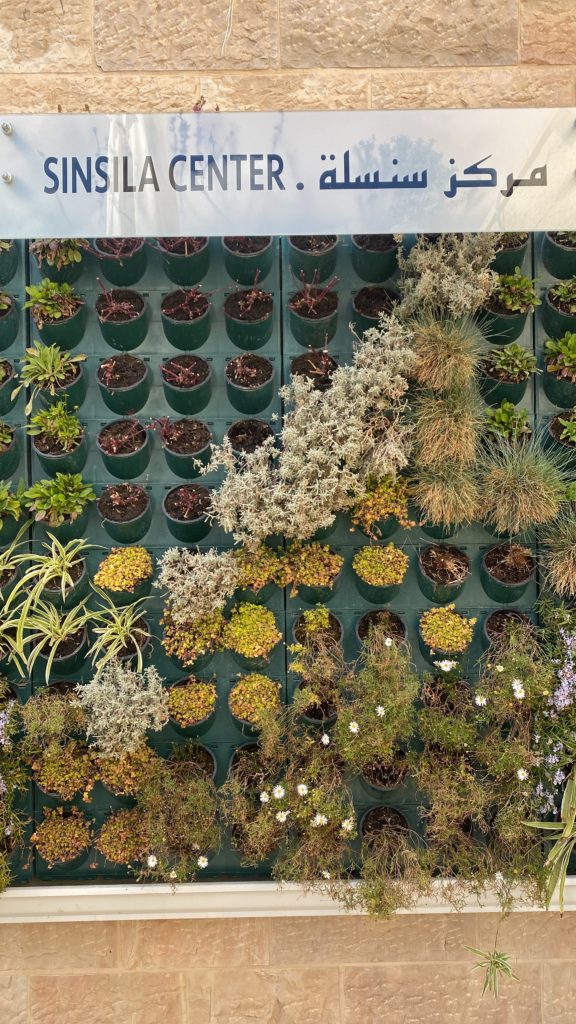
Lunch at a local Ethiopian restaurant was followed by a visit to Sinsila, a kind of sister organization to Muslala in East Jerusalem, founded by architect and urban planner Tareq Nasser. Beautiful vegetables were in full bloom on their patio and honey – from the bees kept by Palestinian women trained at Sinsila – was on sale (and for the tasting – I bought quite a bit…)

Are you tired yet? They were. We had drinks at the beautiful American Colony Hotel and got to talk about so many things that have come up in the past complicated days. Which were further complicated when we went to Yad Vashem the next day. We were led by an incredible tour guide who is the daughter of survivors and an artist herself. Going through these difficult exhibitions with the thread of art connecting one wing to the next was profound. And the work in their Art Museum was astonishing in its breadth and depth. A drive through the Jerusalem Forest to a late lunch in Beit Zayit (in a room where the sun poured in from every side) made room for some transition out of that darkness.

Wednesday we had a peek into the Tower of David, which is under renovation but still has an astonishing view. Then through the Christian quarter and into the Church of the Holy Sepulchre which was blessedly NOT crowded. My favorite moment was watching a sole nun sweeping the expansive floor in the center of the Church.

Andi Arnovitz then led us on a tour of the Jerusalem Print Workshop. Founder Arik Kelemnik held forth (at 80 years old), a bit on the history of the workshop including the new methodologies in printmaking devised by some of the artists working there over the last 50 plus years. He also took us through a stunning exhibit of the work of master printmaker Moshe Gershuni. I learned that Rakefet (Cyclamen) is another name for Jerusalem.

We should stop here but there really was one more incredibly interesting day. Our guide, Leah Kufield – formerly Haredi, now identifies as a Dati Leumi (Orthodox zionist,) explained, in detail, the differences between Haredi and Orthodox and Hasidism and so many other nuances of Orthodox identity. She took us through Mea Shearim where it was “erev” Shushan Purim. (Thank you Malcom Thompson for explaining that in walled cities, Purim is celebrated over 2 days.) Some children were in costume and there were odd masks for sale on the narrow streets. Like East Jerusalem, the streets were dirty, there was a lot of garbage, everything was badly maintained and the place read of poverty. The MOST surprising thing was to see the Palestinian Flag flying high in the middle of the middle of the neighborhood. Strange bedfellows.

Ok – I’m exhausted and that was a week ago. I promise to share more – thankfully this past week was about settling down a bit. Thank you YMCA for the Fellows’ free passes to the beautiful new Sports Center – they are all feeling SO much better.

First days of the residency

Nermeen Shweiki · Mar 18, 2022 · Leave a Comment

(Elise Bernhardt – March 12, 2022)

Vibha arrived from India in the early hours on Friday, March 11.  Everyone else was asleep; having had 2 intense days of touring from (already) multiple perspectives.  

To start the adventure on Day 1: Dari Gil led an extraordinary tour, starting with an overlook of the Jerusalem from the Mount of Olives.  Her crystal-clear explanations about historical movements and forces that shaped the city and the meanings of places like Gethsemane, the other side of the Western Wall and so much else, brought a richness to the discovery of the city that was new to me (and I’ve been on ALOT of tours.) On the way up to the ramp to the Dome of the Rock and El Aqsa, we encountered a bar mitzvah that traveled from the gate of the city towards the Wailing Wall. I could see the Fellows swept up in this 10 AM joyousness (a great clarinetist accompanied their little procession.) Dari was greeted right and left by guides, security officers, etc.  She is apparently the youngest person to be certified as a guide and she is well known. (She is taking a group from the Kennedy School next week – we are in good company!  

There aren’t words to describe what James Snyder calls “one of the world’s great plazas.”  Herod really outdid himself and it feels a bit like being on the top of the world up on this plaza. There is abundant space around and between El Aqsa and Dome of the Rock. And the relationship between the buildings and the sky is indescribable. We were especially lucky to have a clear blue sky with puff ball clouds The contrast/connection between the tiles on the Dome of the Rock and the sky was stunning. Such blues…and of course the Gold dome, and  the little structure that is said to be exactly covering the spot where Abraham brought Isaac to be sacrificed is right there. And its where Mohammed flew to. If architecture is destiny, this is also the spot where the high priest came once a year. The holy of holies! Plus, there is a door in the mosque that appears as if it is exactly where the entrance to that space would have been.  

As we were topping the steps towards the Dome of the Rock, I wanted to truly capture the depth of the religious conflict that is literally over the meaning and importance of one stone (was Jesus here too?  I have no idea…) I asked Dari, so is this where the rock was where Abraham was going to sacrifice Isaac – and before she could answer, a guard said “NO.”  Apparently, that would not have been disputed by him some 20 years ago. Today there is a denial of the importance of this place to the Jews.  

We left the Temple Mount and headed into the Arab quarter of the old city, passed the first 3 stations of the cross, and moved around to the famous portion of the Western Wall. It was interesting for me to hear how Dari was able to explain so much of the complexity of the men’s side, the women’s side, the meaning to so many people the history of this wall and the remaining portion that has finally been opened up for mixed groups, the meaning behind the millions of notes tucked into the crevices, and why people walk backwards away from the wall. 

The Fellows had so many astute and insightful questions throughout this talk. New to this country, and mostly new to all the Abrahamic religious practices, they are having to digest thousands of years of history and geography, the nuances of identity, the divisions and slices within each religious group, and so much more.  

In the afternoon, starting with a delicious hummus lunch in the Old City, we met with Green Olive tour guide Mohammed Barakat, a longtime resident of East Jerusalem who has been taking groups on tours of “the seam”, the West Bank and beyond for many years. Mohammad spoke of his personal experiences, going back to the time of his grandfather. We made our way through New Gate around to the edges of East Jerusalem to the Museum of the Seam and the Qalandia check point. What an absolutely unnecessary, infuriating and humiliating experience that was. Mohammad explained the complexity of ID cards and passports and the rights (or lack thereof) for East Jerusalemites – particularly for Palestinians outside East Jerusalem. For me, it has always been hard to understand who identifies in what way and his very specific personal examples helped to clarify. He also talked about the crazy rules of keeping/losing one’s home. Proving personal residency throughout the period before 1948 is made exceedingly difficult and Israel is able to take over peoples’ properties even when they, or some member of their family, has lived there for decades.  

As we keep saying, it is complicated.

Friday morning at Beit Hansen, at their fabulous farm to table restaurant, we met tour guide Tanya Geiger, who is an expert historian and a local, lifetime resident. We talked about identity over breakfast and she explained that it is a very normal question to ask. She identifies first as a woman, then as a Jew and then as an Israeli. She talked about struggling as a Modern Orthodox woman and a feminist. That conversation took place along a kind of secret route past the old Natural History Museum and into a lovely community garden that Maya Halevy brought us into. We sat sheltered from the considerable cold and wind in a walled/covered gazebo while Tanya explained the role of the Templars in the building of this beautiful neighborhood in West Jerusalem. More info that I never knew.  

From there we went with Maya to the Bloomfield Science Museum over which she has presided for over 25 years. We started in the lab, an incredible warren of workshops where they make all their exhibitions, including ones for other museums. The engineers who work there are clearly as happy as anyone could be in their job. Everyone on the team Maya has created and oversees radiates a warm sense of loving their work. She is incredibly knowledgeable about the intricacies of the science behind the exhibits and there is a pervasive feeling of fun and discovery. There are so many children and parents and places to play and move and be curious and creative. Anna is already known to the staff and I know she is going to have an amazing time there.

By the end of this time, everyone went home to collapse, myself included. Later we went to Ruth Cummings’ home for a beautiful shabbat dinner which included Elad, his partner Miguel and Melhem. Ruth got everyone started with the prompt… Where were you born, where do you live and tell us one thing that is not on your resume. We learned so much. Elad is a “Tea-rista,” Claudia lived in four countries and played cello, Anna started a fashion show in High School which almost went to MTV, Sofia is the youngest of five and stayed in a castle somewhere in France and met the President. Melhem grew up in a Druze village in the very north of Israel and read his first Hebrew book, a famous work of philosophy, when he was 16 – and then Nietzche and decided to become a philosopher.

Coming up next – tomorrow we will visit and see more of how he has moved his incredible drive and intelligence to shape the Ibdaa School of the Arts; the school he founded and runs. 

Pattern

Anna Lublina · Mar 16, 2022 · Leave a Comment

(Anna Lublina, 3/16/22)

Wow, what a whirlwind in Jerusalem! We’ve already seen so much— Mount of Olives, Dome of the Rock, Temple Mount, the Western Wall, the Old City, Beit Hansen, all over East Jerusalem, Downtown Jerusalem, and all of our partner organizations— and yet it feels like my feet have barely touched the ground. 


Sinsila Center in East Jerusalem. muslala.org/en/sinsila/

I feel so grateful to be shown all these different threads: different narratives, experiences, expressions, borders, blurred borders, modes of resistance. What a weave we will have by the end of this. 

Reminds me of a poem by Iranian poet Garous Abdolmalekian:

Pattern

Your dress waving in the wind.

This

is the only flag I love. 

  • « Go to Previous Page
  • Page 1
  • Page 2
  • Page 3
  • Page 4
  • Page 5
  • Go to Next Page »

Jerusalem Intl Fellows

Copyright © Jerusalem International Fellows 2022

English
العربية עִבְרִית